The pact on trade in goods under the Comprehensive Economic Cooperation Agreement was signed by Indian commerce and industry minister Anand Sharma and ASEAN economic ministers after more than six years of intense negotiations.

In a veiled reference to China's aggressive military behaviour, Defence Minister Rajnath Singh on Thursday said exercising self-restraint in the conduct of activities and avoiding actions that may further complicate situation will go a long way in bringing sustained regional peace.
Modi, 68, was administered the oath of office and secrecy by President Ram Nath Kovind at a glittering ceremony at the forecourt of majestic Rashtraparti Bhavan.
Swaraj said India has made many efforts to have talks with Islamabad and the only reason they have stopped is because of Pakistan's behaviour.

Rajapaksa has blamed India, the United States and European countries for his humiliating defeat.

The counter-insurgency operation on the Indo-Myanmar was under planning for the last three months. The June 4 ambush that killed 18 Indian soldiers only hastened the attack. Sheela Bhatt provides exclusive details of the planning for the operation.
Prime Minister Narendra Modi has brought Hindi into vogue in the external affairs ministry and managed a diplomatic coup by inviting SAARC leaders, including Nawaz Sharif, to New Delhi for his swearing-in. Sheela Bhatt's impressions of the Indian prime minister's first day in office.

10 takeaways from the prime minister's UN speech.


That Australia is ready for a substantive engagement is evident from its 2013 Defence White Paper, which emphasised the need to build stronger defence relations with India, says Ajai Shukla

In the midst of rising global concern over China's military expansionism, India and three other member nations of the Quad on Thursday vowed to uphold a rules-based international order underpinned by respect for territorial integrity and sovereignty, freedom of navigation and peaceful resolution of disputes.

Internet users in India is attracting cyber criminals, as these are first-timers, who can be duped easily

Modi said Nepal must identify its needs and priorities to deliver results.
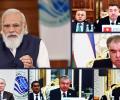
Prime Minister Narendra Modi on Friday called for developing a template by the Shanghai Cooperation Organisation (SCO) to effectively deal with the challenges of extremism and radicalisation.

India has never sought Dawood's extradition, the Pak high commissioner has said.

It seems China is ready to cooperate with India in the central Asian region through the SCO framework, the reasons for which are manifold, says Sana Hashmi.

India says it cannot accept a project that ignores its core concerns on sovereignty and territorial integrity.

The cascade of cordiality on both sides after the Modi-Sharif handshake in Paris was preceded by much planning and even goading from UK, US and Germany.

Had India agreed to join the trade pact, Indian markets would have been flooded with cheap Chinese products.

Having invested close to $15 billion in Indonesia, Indian firms have lined up further $15-16 billion investments.

Describing India as an "emerging democratic superpower", Australian Prime Minister Tony Abbott on Thursday kicked off his two-day India visit during which the two countries are likely to clinch an elusive civil nuclear deal.

Countries that have signed the RCEP agreement can start negotiations with India for joining the pact once New Delhi submits a written request stating its intention for the same, according to a declaration. On November 4 last year, India walked out of mega free trade agreement RCEP (Regional Comprehensive Economic Partnership) as negotiations failed to address New Delhi's outstanding issues and concerns. The remaining 15 member countries have signed RCEP agreement and have stated that the pact would remain open to India.

Modi assured Trump that India will try to 'live up to the expectations' of the US and the world and also thanked the US President for speaking 'highly' about India during his trips.
In its 28-page report, the CRS noted that Pakistan's nuclear arsenal is widely regarded as designed to dissuade India from taking military action against it, but Islamabad's expansion of its nuclear arsenal, development of new types of nuclear weapons and adoption of a doctrine called "full spectrum deterrence" have led some observers to express concern about an increased risk of nuclear conflict between Pakistan and India, which also continues to expand its nuclear arsenal.
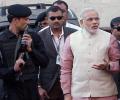
The people in charge of the PM's security need to shift the emphasis from the numerical (the number of policemen deployed) to technology-based solutions to sanitise the area where he resides, works and during his road journeys, says Anil Chowdhry, former secretary (internal security), ministry of home affairs.

Because of the treaty, no big dams or power projects can be built by India on Jhelum, Indus or Chenab.

She also addressed the Indian Community at a reception held in her honour in Jakarta.
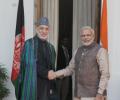
Security will be a consideration, as would protocol, but given Modi's penchant for the unconventional, it should not come as a surprise if he indeed decides to attend the ceremony in Kabul, says Ramesh Ramachandran.


At a time when China is trying to make its foray into South Asia, India should use its shared history to strengthen its ties in the region, says Dr Rup Narayan Das.

The UPA Government is trying to push through the second wave of airport privatisation before the elections and the controversial elements of this process threaten to harm the sector.
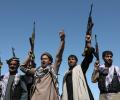
'But an overthrow of the Afghan government would really embolden regional militant groups in a big way.' 'LeT and JeM could be emboldened, and prompted to replicate in Kashmir what the Taliban did in Afghanistan.'

'While military acts such as the Uri surgical strikes are one option, cultural, economic and diplomatic isolation should also be part of the arsenal,' argues Sankrant Sanu.

Vikas Swarup says India unlikely to give Pathankot-like offer to Pak in Uri attack probe.

Former external affairs minister, K Natwar Singh, shares his critique of the Narendra Modi government's foreign policy in this e-mailed interview with Aditi Phadnis. Edited excerpts

'The entire Ufa fiasco was predictable and predicted. The Ufa venue had created international interest in the initiative and its failure may have implications for both Pakistan and India. What remains for Modi to do is to produce a prettier rabbit out of his hat next time to deal with the Pakistan imbroglio,' says Ambassador T P Sreenivasan.
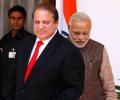
The government has returned to talks with Pakistan, but can it withstand pressure from a jingoistic press and a rabidly nationalistic social media.

Access to Sabang Port will allow the Indian Navy to dominate Malacca Strait more effectively, reports Ajai Shukla.

Eyeing greater cooperation with South East Asian countries on economic and security issues, India on Thursday announced a separate Mission for ASEAN region to be set up in Jakarta with a full-time resident Ambassador.

By hosting the 10 ASEAN leaders on Republic Day, India amply demonstrated that ASEAN is a central pillar of its Act East policy. But is India 'central' for ASEAN, asks Dr Rahul Mishra.
